Echoes in Motion
A 12-track ambient electronic journey exploring themes of memory and movement, recorded over a single winter in the studio.
About the record
Echoes in Motion began as an experiment: could an entire album grow from a single recorded note? Most of these pieces started with two seconds of piano or bowed guitar, stretched and reshaped until the source disappeared and only the feeling remained. The result is an hour of music that never sits still — swells rise and dissolve, motifs drift back changed.
It was recorded over one quiet winter, largely at night, and it sounds like it. If you'd like the making-of, I wrote about the approach in Building ambient textures that breathe.
The brief
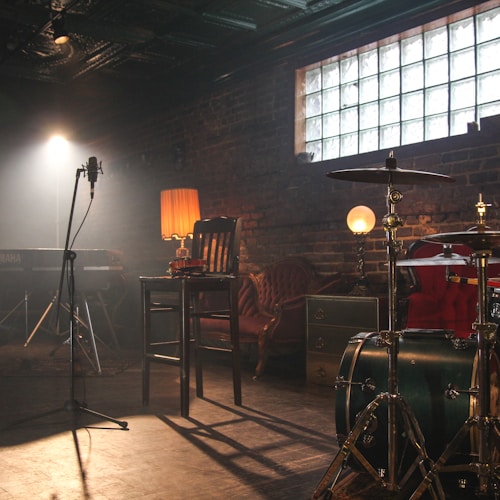
This one had no client and no deadline — which meant it needed a constraint to stop it drifting. I set a single rule before writing a note: every sound on the record had to originate from a real performance captured in this room. No preset patches, no sample libraries. If I wanted a string swell, I had to bow something and record it.
The challenge
Ambient records fail in a predictable way. They establish a beautiful texture in the first ninety seconds, then have nowhere left to go for the next forty minutes. A deliberately narrow palette makes that risk worse, not better. The entire production problem here was how to keep forty-seven minutes genuinely moving when the raw material is essentially eight recordings of an upright piano and a bowed guitar.
Approach
- Source once, transform endlessly. Every pad on the record is granular processing of a two-second acoustic take. Stretched far enough, a piano note stops being a piano and becomes weather — but it keeps the tiny irregularities that tell your ear a human was in the room.
- Hand-drawn automation instead of LFOs. Volume and filter movement were drawn in by hand across whole sections. A perfect sine modulation sounds like a machine; an uneven curve sounds like someone leaning into a fader.
- Motifs that return changed. Three short melodic cells recur across the album in different harmonic contexts. The listener recognises something without being able to say what, which is what makes a long record feel composed rather than assembled.
- Sequencing as structure. The running order was rebuilt four times. Density rises to track seven, drops almost to silence at eight, then rebuilds — the album's actual arc lives in that sequencing, not in any single piece.
Credits
- Written & producedAlex Rivera
- Mix & masterAlex Rivera
- Cello (tracks 3, 7)Mara Ellison
- Upright pianoAlex Rivera
- Field recordingsRecorded on location, Northern California
- ArtworkIlse Braun
- Vinyl cutRidge Lane Cutting Room
Technical notes
Outcome
- Picked up by three editorial ambient playlists in its first month
- First vinyl pressing of 300 sold through in six weeks
- Two tracks licensed for documentary use, one for a gallery installation
- Directly led to the Beyond the Horizon scoring commission
Tracklist
- 1Floating Cities4:12
- 2Slow Light3:48
- 3Echoes of Time5:02
- 4Undertow3:56
- 5Hidden Past4:20
- 6Northerly3:31
- 7Glasshouse4:05
- 8Long Exposure3:44
Floating Cities
The album's opener — press play; nothing loads until you do.
Related projects

Want something like this for your project?
Full-service production from first idea to final master — let's talk about what you're making.
Start a conversation